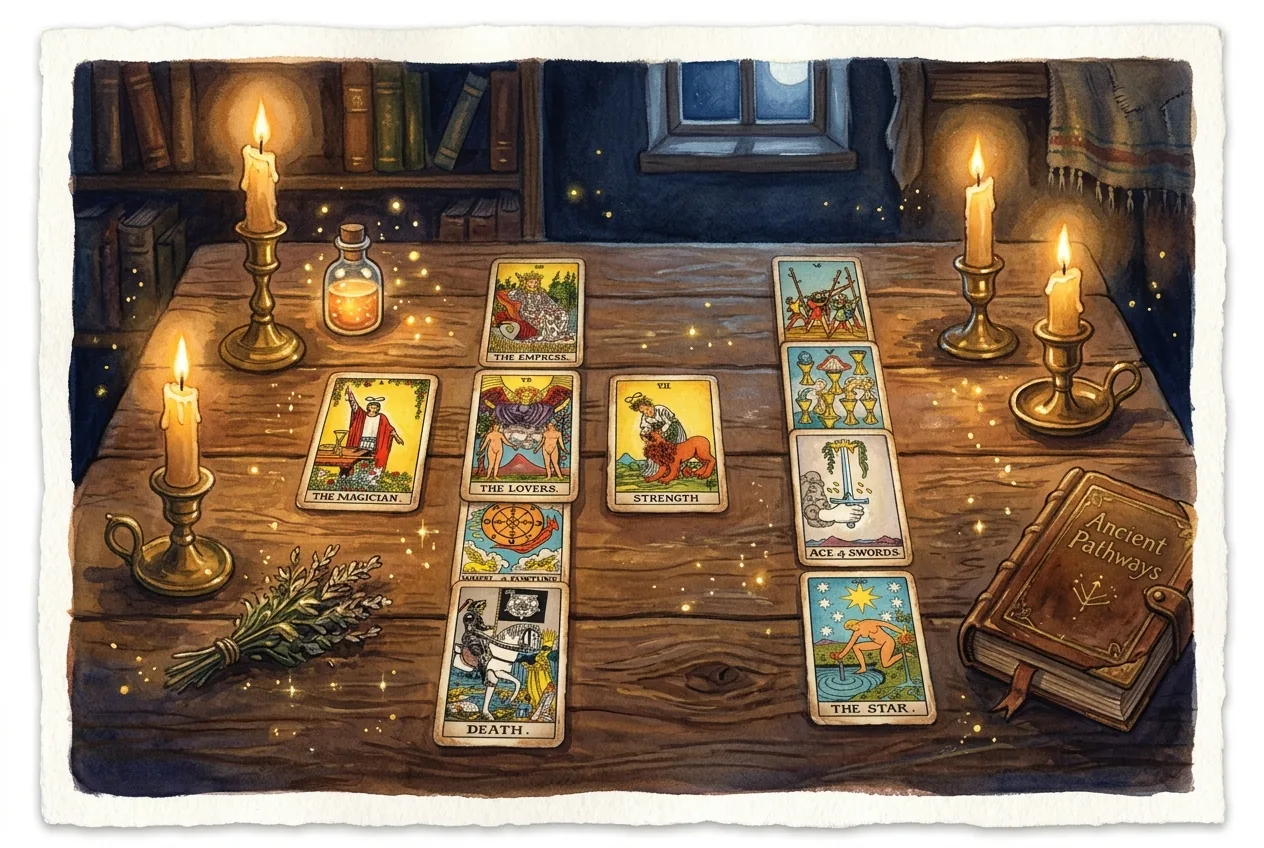
Ten cards laid out in a cross and a line — I know, querida, it looks like a lot. The first time someone shows you the Celtic Cross it feels like you need a map just to find the front door. You don't. It's one story, told in two movements, and once you see the shape you'll never un-see it.
Let me walk you through it the way my grandmother walked me — slowly, with a cup of coffee, finding the key together. We do the cross first, the heart of the matter, then the staff, you and the world around it.
The cross — the heart of the matter
The first six cards make the cross, and they're the soul of the reading. Card 1 is the present — where you honestly stand right now. Card 2 lies across it: the challenge, the thing cutting through. Read those two together first, because that crossing is the spine of everything else.
Then around them: card 3 is the root underneath (what this quietly grows from), card 4 is the recent past (what's just slipping behind you), card 5 is the conscious goal above (what you're reaching for, or telling yourself you want), and card 6 is the near future (what's walking toward you next).
The staff — you and the world
The last four cards stand in a line beside the cross. Card 7 is your stance — how you're carrying yourself through this. Card 8 is the outside forces: the people and circumstances around you that you don't fully control. Card 9 is your hopes and fears (and so often it's the same card wearing both faces at once). Card 10 is the outcome — where it all leads if nothing shifts.
That last card is the one everyone rushes to. Don't. It only makes sense once the other nine have spoken.
Read it as one story, not ten cards
The mistake everyone makes the first few times is reading ten little fortunes in a row. Resist it. Find the tension in the center, feel how the root feeds it and where the near future is pulling, and let the outcome land as a likely direction — one you can still change, not a sentence handed down.
The cards are talking to each other. Your job is to listen for the conversation: which card answers which, where the energy moves, what the challenge is really protecting. That's the difference between a list of meanings and a reading.
When to reach for it
The Celtic Cross is for a big, tangled situation you want to see from every side — a crossroads, a heavy relationship, a "what is really going on here." It rewards a real question and a little patience.
For a quick yes/no or one small thing, it's too much house for one room. Use a smaller spread and save the Cross for when the question deserves the whole table.
Don't rush it. Lay the cards, find the crossing in the middle, and let the story tell itself — the outcome card is the last word, not the only word, and it's a door, not a lock.
When you're ready to read a big question from every angle, come sit with me and we'll find the key together.