The Hierophant upright meaning
The Hierophant is the card of what has been handed down: traditions, institutions, teachers, ceremonies and the shared beliefs of a group. He stands for learning the established way before you change it, through a mentor, a school, a faith, a family custom or a professional standard.
Upright, it favours the conventional route: asking someone who has done it before, following the proven method, marking a commitment in a formal way. Belonging to something larger can steady you.
The Hierophant reversed meaning
Reversed, the form has lost its meaning. Rules that once protected something now only restrict, and you may feel pressed to fit a mould that doesn't fit you.
It supports questioning and finding your own path, but keep what still works. Throwing out all of the old way can lose real wisdom along with the empty ritual.
The Hierophant in love
In love, The Hierophant points to commitment in the traditional sense: shared values, meeting the family, marriage or another formal step. Reversed, the relationship may not follow the expected script, or there may be friction with family expectations.
The Hierophant at work and with money
At work, it favours mentors, training, qualifications and established organisations. Reversed, you may be outgrowing a rigid workplace or want to do things your own way.
Is The Hierophant a yes or no card?
Yes. Yes, if you go the established way and ask someone who knows. A single card leans rather than rules: read it with your question, and let a reversed card add friction or delay before you call it a flat no.
The picture on the card
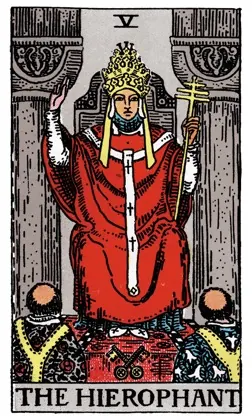
A teacher in red and white robes sits between two grey pillars, raising one hand in blessing and holding a triple cross in the other. Two followers kneel before him, and two crossed keys lie at his feet.
How Mae and Vera read The Hierophant
Maevera is one familiar with two souls. Mae is quicker to feel what's possible and what's calling; Vera is quicker to see the evidence, the cost and what needs protecting. Neither is always right. They differ in where they look first, and a reading is what they do together.
- Mae
- Mae asks why. She wants to know whether the old key can still open a new room.
- Vera
- Vera listens first to what the tradition was meant to protect, and watches for the moment form replaces meaning.
- Together
- Together they keep the principles that are still alive, and leave the authority behind without throwing the experience away.